I have come to learn that in reference to cinema studies perspective, ‘the Atomic Café’ is about the nuclear warfare. It is a documentary film which depicts events between the 1940s and 1960s to the audience. In Atomic Café, there are set of other A-Bomb films we studies recently as well as those of the cold war such as the Korean War, Cold war spy film, U.S. Army training films and parts directly from the U.S. Government Archives, etc. Example: part of the ‘inside of the plan that dropped the A-bomb on Hiroshima’, the special effect of the mushroom cloud, the picture of the burnt city of Hiroshima as in ‘the beginning and the end’ film and the pictures of the fallout shelters in the film, ‘the blast of the past’. As per the music, the film contains some songs of the cold war and soundtrack of the atomic bomb [“atomic bomb baby”]. After five years of work, in October of 1982, “The Atomic Café” was produced by Jayne Loader, Kevin and Pierce Rafferty in English. It is also confirmed that this firm was released during the Reagan era, at the climax of the international disarmament movement. As such, the production of the film received wide distribution till it became a cult classic. It is believed that the project of “the Atomic Café” film may have cost about $300.000
Conclusively, ‘the Atomic Café is said to be a "compilation verite", a film which is made up of no new footage, no voice of God narration, rather a set of other films as mentioned above. [Atomic Café: History Done Right]
Thursday, November 11, 2010

Wednesday, November 10, 2010
Scar of memory-My comment of the Atomic Cafe

This is a film of the atomic culture that was star in the America and still popular now, from the film we can see the people at that time try to built a lot of funny things with the atomic bomb, they make the music they make it became the food and drink, the car the bar the cloth the novel… a lot people was falling love with the atomic bomb and the culture it bring to us. But we still can see another sense that every rich American should have a yard with a shelter that can protect them from the fall out, the government try to make citizen pay more attention on the nuclear attack from the USSR.
This is a time period with a lot things cannot give a clearly definition that it is a good period or bad period just as the atomic bomb. I should said that as Chinese I should said that I should thanks for the bomb and also as a person like game and film also should say thanks for the atomic bomb and the culture it brings to. But when we see the film about what should to when you attack by the nuclear weapon, and the US people spend a lot of money to built a shelter, even the people who live in the Nagasaki and Hiroshima, could us still said that is a good time the atomic bomb is good weapon.
Atomic Café just show us at that time the people’s thinking and the fear of the atomic weapon, even the US people make it become culture but everyone knows that they were under the shadow of the atomic attack this is also the same situation with the USSR people. Though this documentary I saw the scar of the memory for the people at that special time. But they bring us the happy till now which is the atomic culture.
The country wants institution of the supremacy by the nuclear weapon but it bring to the people a scar in their mind, may by when we play game or watch film try to think more about them.
Scar of menmory-the start with the Atomic film,time line

I Live in Fear, a 1955 Japanese film directed by Akira Kurosawa, is about a Japanese businessman who is terrified of nuclear and was among the earliest films to deal with the psychological impact of nuclear weapons. Many films, some of which were based on novels, feature nuclear war or the threat of it. Godzilla (1954) is considered by some to be an analogy to the nuclear weapons dropped on Japan, another pre-dating film The Beast from 20,000 Fathoms being the start of a more general genre of movies about creatures mutated or awakened by nuclear testing. Them! (1954) (giant ants in Los Angeles sewers) is based on a similar premise. The Incredible Shrinking Man (novel) (film, 1957) starts with a sailor irradiated by a bomb test, based on a real incident of irradiation of Japanese fisherman. In A Canticle for Leibowitz, (novel, no film, 1959) the previous war is known as the "Flame Deluge"; On the Beach (novel 1957, film 1959) is most famous for making the end of humanity a theme in popular thinking on nuclear war; Final War (Japan, 1960) nuclear war erupts after the USA accidentally bombs South Korea. The 1962 film This is Not a Test addresses the reactions and emotions of a group of people in the minutes prior to a nuclear attack. Some non-fiction works of the time had an effect on cultural works. Herman Kahn's innovative non-fiction book On Thermonuclear War, (1961) describing various nuclear war scenarios, was never widely popular, but the seeming outlandishness of its projections and the possibility of a "Doomsday Machine" (an idea Kahn got from Leo Szilard before relatively small, deliverable thermonuclear weapons were developed in 1954) as a way to prevent war were direct inspirations for director Stanley Kubrick to handle Dr. Strangelove or: How I Learned to Stop Worrying and Love the Bomb as a black comedy. (Menand, 2005) The 1964 film was loosely based on Red Alert, and a later novelization of the film was also written by the original author Peter George. Fail-Safe (novel 1962) (film 1964) (live-tv remake 2000) was a dramatic version of a similar accidental war that came out soon after. The War Game (BBC TV film, 1965) was a documentary-style film about the effects of nuclear war on England while Planet of the Apes (1963 novel, and five films 1968-1973) was about an Earth ruled by apes because of a nuclear war that eventually ended due to a nuclear bomb. Damnation Alley (1977) features a chilling launch and destruction sequence, followed by a trek across a ruined America; Taiyō o Nusunda Otoko / The Man Who Stole the Sun (1979), When the Wind Blows (British graphic novel 1982, animated film 1986). Special Bulletin was a 1983 made for TV movie about anti-nuclear activists detonating a home built nuclear device in Charleston, South Carolina. The Day After became known for its realistic representation of nuclear war and groundbreaking special effects for a television movie.The Day After (1983) was a "made for TV" movie that became fodder for talk shows and commentary by politicians at the time due to its depiction of explosions on American soil and alleged political content. Testament (1983), another postwar vision; WarGames (1983), features a young computer hacker who nearly starts World War Three when he inadvertently breaks into a fictional NORAD supercomputer named WOPR (War Operation Plan Response) to play the latest video games; The Terminator (4 films, 1984, 1991, 2003, 2009) features a post-apocalyptic future (all James Cameron films from 1986 through 1994 deal with nuclear explosions); Red Dawn (film, directed by John Milius) (1984), Mad Max (3 films, 1979–1985), Manhattan Project (1986, not about the Manhattan Project), Threads (BBC TV production made 1984, shown 1985), based on British government exercise Square Leg, Project X (1986) which deals with animal testing on exposure to nuclear radiation, Miracle Mile (1988), Broken Arrow (1996) ("Broken Arrow" is military jargon for an accidental nuclear event, the event depicted in the film would actually be classified as Empty Quiver). The James Bond films are also known to have plots surrounding nuclear weapons. Films like Thunderball, The Spy Who Loved Me, Octopussy, Tomorrow Never Dies, and The World Is Not Enough involves a plot of nuclear warfare by the enemy, but in a lighter point of view (the weapons are never set off as Bond usually stops them last minute to add to the thrill of the film). In Goldfinger, the titular antagonist attempts to irradiate the US's national gold reserves with an atomic bomb, in order to increase the value of his own stockpile. There have been a few fictionalized accounts of historical events relating to nuclear weapons as well. The Manhattan Project itself, for example, was depicted in the 1989 movie Fat Man and Little Boy. In the miniseries Battlestar Galactica, Caprica (pictured) and the Twelve Colonies of Kobol suffered a massive nuclear attack from the Cylons.The second season of the television series 24 involves Muslim terrorists smuggling a nuclear bomb across the Mexican border and planning to detonate it in Los Angeles. In the fourth season, after a series of terrorist attacks, a group of Islamic terrorists capture and launch a nuclear cruise missile at Los Angeles. The sixth season also involves nuclear weapons as a major theme, with a group of terrorists having access to five nuclear suitcase bombs. Nuclear weapons, both conventional and "enhanced" (through the use of fictional advanced technology), are used in the feature film Stargate and the related television series Stargate SG-1 and Stargate Atlantis. The Tom Clancy novel and movie The Sum of All Fears depicts a nuclear explosion caused by Islamic terrorists in Denver (novel) or by neo-Nazis in Baltimore (film). The movie On The Beach is based around the premise of a nuclear war, fought over the territorial rights of Taiwan. In the comic The Invisibles, writer Grant Morrison references Oppenheimer using the "Destroyer of Worlds" quote as a mystic phrase and using the moment of detonation as part of a magical ritual. The roleplaying game GURPS Technomancer repeats this theme, depicting an alternate history where Oppenheimer unwittingly completes a necromantic ritual that releases magic back into the world at Trinity. The CBS Television Drama Jericho (2006) focuses on a small town that is left without communications and basic necessities after a nuclear attack on major US cities. The film The Hills Have Eyes (2006) features a group of miner's descendants in the New Mexico desert, who have become genetically mutated due to the radiation caused by the atomic tests, and terrorize travelers in the area, who are lured to their mines in the hills by a gas station owner who profits from the victim's jewelry. There have also been a number of plays set around the theme of nuclear weapons development. Michael Frayn's Tony Award-winning Copenhagen (1998), for example, contemplates the ethics and early history of nuclear weapons development through the eyes of the physicist Niels Bohr, his wife Margarethe, and his former pupil Werner Heisenberg. Swiss playwright Friedrich Dürrenmatt addressed the question of the responsibility of scientists in a post-Hiroshima world explicitly in his 1961 satire, Die Physiker. The rise-and-fall of American physicist and "father of the atomic bomb" J. Robert Oppenheimer has been the subject and inspiration of a number of plays—Heinar Kipphardt's In the Matter J. Robert Oppenheimer (1964) — and even an opera, Doctor Atomic (2005). In Indiana Jones and the Kingdom of the Crystal Skull (2008), set in 1957, Indiana Jones finds himself in a nuclear test site in Nevada that has been set up to resemble a suburban area while being chased by Soviet soldiers. Realizing he has a matter of seconds before an atomic bomb detonates, he locks himself in a lead-lined refrigerator. The bomb flings the refrigerator a safe distance away, where Jones emerges without any serious injuries. The third episode of Lost's fifth season, "Jughead," reveals that the United States military brought a hydrogen bomb called Jughead to the island in 1954; the military troops were killed by the Others and the bomb was seized. A time-traveling Daniel Faraday convinces the Others that he is part of a military science team sent to defuse the bomb, which is leaking radioactive material, but eventually confides to one of their members that the bomb must be buried underground after being sealed with lead or concrete, explaining that he knows this will work because the island is still intact 50 years later, having never been destroyed in a nuclear blast. However, in 1977, the bomb was used in an attempt to stop the Incident, in the hope of changing the futu
Movie list
The Beginning or the End (1947)
Invasion U.S.A. (1952)
The War of the Worlds (1953)
The Day the Earth Caught Fire (1961)
The Last War (1961)
Panic in Year Zero! (1962)
This is Not a Test (1962)
Fail-Safe (1964)
The War Game (1965)
The Bedford Incident (1965)
A Boy and His Dog (1975)
Damnation Alley (1977)
Superman (1978)
Special Bulletin (1983)
The Day After (1983)
Testament (1983)
Threads (1984)
Countdown to Looking Glass (1984)
The Return of the Living Dead (1985)
When the Wind Blows (1986)
Miracle Mile (1988)
By Dawn's Early Light (1990)
Terminator 2: Judgment Day (1991)
True Lies (1994)
Broken Arrow (1996)
Independence Day (1996)
The Peacemaker (1997)
The Peacekeeper (1997)
Godzilla (1998)
Babylon 5: In the Beginning (1998)
Babylon 5: Thirdspace (1998)
Armageddon (1998)
Atomic Train (1999)
Chain of Command (2000)
The Sum of All Fears (2002)
Alien Hunter (2003)
Paycheck (2003)
The Core (2003)
Terminator 3: Rise of the Machines (2003)
Resident Evil: Apocalypse (2004)
The Hills Have Eyes (2006)
Alien vs. Predator: Requiem (2007)
Indiana Jones and the Kingdom of the Crystal Skull (2008)
Terminator: Salvation (2009)
Watchmen (2009)
The Crazies (2010)
The Beginning or the End (1947)
Invasion U.S.A. (1952)
The War of the Worlds (1953)
The Day the Earth Caught Fire (1961)
The Last War (1961)
Panic in Year Zero! (1962)
This is Not a Test (1962)
Fail-Safe (1964)
The War Game (1965)
The Bedford Incident (1965)
A Boy and His Dog (1975)
Damnation Alley (1977)
Superman (1978)
Special Bulletin (1983)
The Day After (1983)
Testament (1983)
Threads (1984)
Countdown to Looking Glass (1984)
The Return of the Living Dead (1985)
When the Wind Blows (1986)
Miracle Mile (1988)
By Dawn's Early Light (1990)
Terminator 2: Judgment Day (1991)
True Lies (1994)
Broken Arrow (1996)
Independence Day (1996)
The Peacemaker (1997)
The Peacekeeper (1997)
Godzilla (1998)
Babylon 5: In the Beginning (1998)
Babylon 5: Thirdspace (1998)
Armageddon (1998)
Atomic Train (1999)
Chain of Command (2000)
The Sum of All Fears (2002)
Alien Hunter (2003)
Paycheck (2003)
The Core (2003)
Terminator 3: Rise of the Machines (2003)
Resident Evil: Apocalypse (2004)
The Hills Have Eyes (2006)
Alien vs. Predator: Requiem (2007)
Indiana Jones and the Kingdom of the Crystal Skull (2008)
Terminator: Salvation (2009)
Watchmen (2009)
The Crazies (2010)
Detail aviliable on : http://en.wikipedia.org/wiki/Nuclear_weapons_in_popular_culture
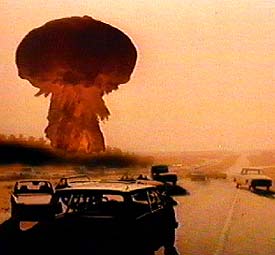
The Theme of Cynical Criticism Included in the Movie
The movie, “Atomic café” is a documentary movie about the nuclear weapon. The movie is constructed by the real images and the voice from news and radio broadcasted in the time, which includes the images of victims of Atomic bomb. Unlike the serious and gloomy atmosphere of the images, the back music used in this movie is all concerned of the nuclear weapon in the United States at the time. From the rhythmical and cheerful tone of the music, we can see the positive image to the nuclear weapon at the United States at the time. The tragic symptom appeared on the body of the victims of the A-bombs, the soldiers rushing toward the mushroom cloud, and the pop music disagree with those images tells us the actual condition of the nuclear weapon and the public opinion about it in the United States at the time ironically.
Officially, the movie is an anti- nuclear weapon movie satirized the politic system of the United States at the time, but another theme included in this film is the fear of the political propaganda carried out by the American government.

 Mr. and Mrs. Rosenberg who were doubted to be the spy from the Soviet Union and carried out the death sentence although there were no enough evidence to it, soldiers who were thrown into the nuclear weapon test site without any protection, and students who hide under the desk as a way of the protection from the A-bomb, although we all know that they are ridiculous actions to mention the danger of nuclear weapon, they were actually carried out under the propaganda at the time. What we can see through it is the large influence the political propaganda gives to the public,
  and people’s ignorance about the nuclear weapon.
 The movie is only constructed by the images that are originally existed as the record of the test, or the news. Because of the difficult process, the movie is said to be took about five years to be completed. However, the vivid description of the time was sharply represented in this film under the method, and that is why the movie is very persuasive and outshines even today.
Tuesday, November 9, 2010
Further reading
Just have a look in this pdf file to get the general ideas and the historical context of the movie "The Atomic Cafe"
http://www.jstor.org/stable/3697350
http://www.jstor.org/stable/3697350
What I learnt from the movie and what one have to learn from the movie?
Movie “The Atomic Café”, Produced by the Archives Project over five year period is the combination of a wide variety of vintage newsreels clips, television news footage, official government information, film footage, radio and television programs and pop music.
The film The Atomic Café focuses on the use of nuclear weapons used from Second World War from Hiroshima and Nagasaki to the 1960s.
General information about the movie:
Produced and directed by Jayne Loader, Kevin Rafferty and Pierce Rafferty.
Music coordinator: Rick Eaker
Distributor: Archives Project
Release date: April 1982
Some of the fascinating scenes from the movie:
1. The pilots of the planes that dropped the first atomic bombs justify their actions. President Truman, caught "off camera," is joking and smiling before he tells the nation about his decision to drop the bombs on Japan.
2. The Bikini atoll nuclear bomb experiments are shown with U.S. military film, complete with officers telling us how the "little people of the island" were happy to cooperate in the test.
3. The film presents examples of the hysteria and paranoia that accompanied the 1949 explosion of an atomic weapon by the U.S.S.R. A long segment is devoted to the execution of Julius and Ethel Rosenberg, convicted as U.S. atomic spies.
4. Using Cold War propaganda footage, the producers present animations of Russian planes bombing America with atomic weapons. These depictions are accompanied by ominous-voiced narrations and martial music. Perhaps the most surprising segments of the film, for the present generation of young people, are the depictions of nuclear civil defense: these and "duck and cover" exercises in schools, pompous statements by officials, appeals to build bomb shelters in back yards and basements, and priests and ministers agreeing that it might be necessary to keep weapons in the shelter to ward off neighbors who may invade.
The film The Atomic Café focuses on the use of nuclear weapons used from Second World War from Hiroshima and Nagasaki to the 1960s.
General information about the movie:
Produced and directed by Jayne Loader, Kevin Rafferty and Pierce Rafferty.
Music coordinator: Rick Eaker
Distributor: Archives Project
Release date: April 1982
Some of the fascinating scenes from the movie:
1. The pilots of the planes that dropped the first atomic bombs justify their actions. President Truman, caught "off camera," is joking and smiling before he tells the nation about his decision to drop the bombs on Japan.
2. The Bikini atoll nuclear bomb experiments are shown with U.S. military film, complete with officers telling us how the "little people of the island" were happy to cooperate in the test.
3. The film presents examples of the hysteria and paranoia that accompanied the 1949 explosion of an atomic weapon by the U.S.S.R. A long segment is devoted to the execution of Julius and Ethel Rosenberg, convicted as U.S. atomic spies.
4. Using Cold War propaganda footage, the producers present animations of Russian planes bombing America with atomic weapons. These depictions are accompanied by ominous-voiced narrations and martial music. Perhaps the most surprising segments of the film, for the present generation of young people, are the depictions of nuclear civil defense: these and "duck and cover" exercises in schools, pompous statements by officials, appeals to build bomb shelters in back yards and basements, and priests and ministers agreeing that it might be necessary to keep weapons in the shelter to ward off neighbors who may invade.
Wednesday, November 3, 2010
Clear footage about the A-Bomb Dropping in Hiroshima & it s deep impact
We have watched many documentaries in class such as the begining or the end or gembaku no ko about the A bomb dropping in Hiroshima and Nagasaki and i guess it was not very clear watching in black n white footage.
You should not miss this out, if u really wanna understand the deep impact of the bombings on the two cities in Japan. This was recently made documentary and this footage reveals the massive energy that was released by A-Bomb using the latest special effects in filming and technology.
Peace
Khan
Subscribe to:
Posts (Atom)